Louis Pasteur
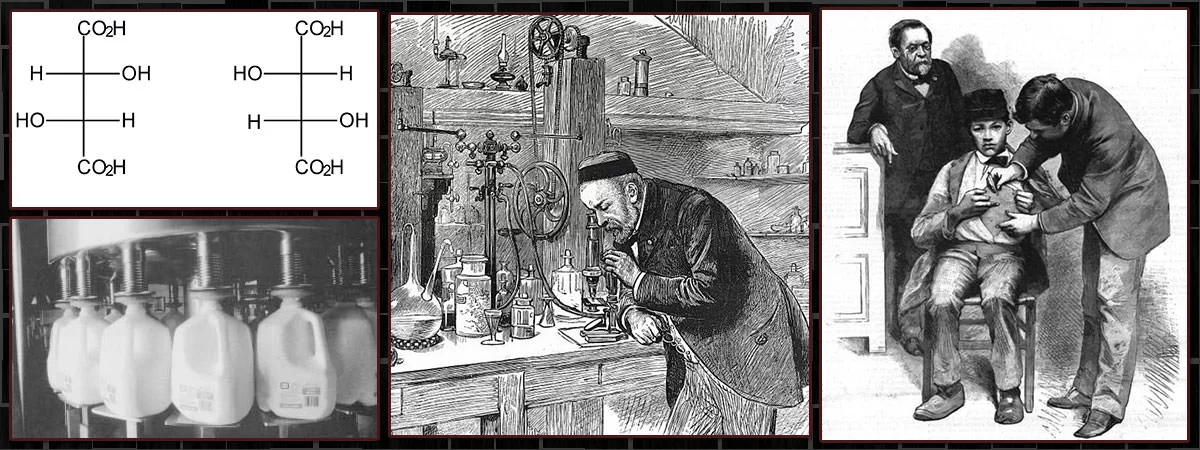
Louis Pasteur (center) and his most notable works: Tartaric-acid(top-left), Pasteurization(bottom-left), and rabbies vaccinations(right)
About Loius Pasteur
Life and Career
- Louis Pasteur was born on December 27, 1822, in Dole, Jura, France.
- Pasteur's early life academic peformance was not really impressive.
- October 1838: went to Paris to join the Pension Barbet, but returned in November.
- 1840: earned a Bachelor of Letters degree in philosophy at Collège Royal of Besançon.
- 1842: took the entrance test for the École Normale Supérieure. He passed but did not attend because of the low ranking.
- 1843: passed the test and enter École Normale Supérieure.
- 1845: received the licencié ès sciences (Master of Science) degree.
- 1846: he was appointed professor of physics at the Collège de Tournon
- 1846-1847: joined the chemist Antoine Jérôme Balard on at the École Normale Supérieure as a graduate laboratory assistant. In the mean time, started his research in crystallography and submitted two theses in chemistry and physics.
- 1848: became professor of chemistry at the University of Strasbourg
- May 29, 1849: married Dijon Lycée.
- September 28, 1895: Passed away near Paris.
Contributions
- Louis Pasteur is one of the three main founders of bacteriology, along with Ferdinand Cohn and Robert Koch. He is also regarded as the "father of microbiology".
- Invented Pasteurization, a technique used for treating milk and wine to stop bacterial contamination.
- Theses on fermentation and germ theory of diseases. He proved that fermentation happens because of living organisms.
- Immunology and vaccination: Discover vaccines for chicken cholera, rabies, and anthrax.
- He discovered the existence of Molecular Asymmetry.
Controversies
- Fermentation by living organisms were said to had been studied by Charles Cagniard-Latour, Friedrich Traugott Kützing and Theodor Schwann in the 1930s, before Louis Pasteur findings.
- Publicization of Pasteur's laboratory notes reveals that his anthrax vaccines use a large amount of work from Jean Joseph Henri Toussaint, who Pasteur did not mention in his final work.
- Experimental ethics: Many of Pasteur's works and procedures were under critism. He practiced medical experienments even though he did not have a medical license. Pasteur's procedures were also under questions because he always kept them secret. It is later revealed that Pasture did not use proper pre-clinical trials on animals before testing the rabies vaccines a human.